
Digital Risk Protection 101: What Is Digital Risk Protection? Complete Guide for Middle East & African Enterprises
Digital risk protection is no longer optional for Middle East and Africa enterprises. Learn the 9 modules of DRP solutions, why regulators require it, implementation timelines, and how to safeguard your organization from external digital threats.


Digital risk protection and digital risks are regulatory requirements across the Middle East and Africa. We've implemented drp solutions at 150+ organizations to mitigate digital risks and safeguard digital assets. A data leak can destroy your brand reputation. Leaked credentials expose your digital environment. Here's what we've learned: most security teams don't understand what digital risk protection service key capabilities do, or why it matters beyond compliance.
Curious about your digital risk posture?
We assess digital risk in one day. Most organizations discover threats they didn't know existed. No obligation. Just clarity.
Key Takeaways
- Digital risk protection is no longer optional. UAE's Central Bank, SAMA, and DFSA all require it. Most Middle East and Africa regulators are moving toward mandatory digital risk protection requirements. Compliance is the baseline. Value comes from threat discovery and breach prevention.
- Traditional cybersecurity doesn't protect external threats. Your brand gets counterfeited on marketplaces you don't own. Your credentials appear on the dark web. Your executives get impersonated. These happen outside your network perimeter where traditional cybersecurity tools can't see them. Digital risk protection safeguards your external digital assets.
- Digital risk protection is 9 interconnected modules, not one tool. Brand Protection, Darkweb Monitoring, Executive Protection, EASM, Supplier Scoring, CTI, Threat Intelligence Platforms, Takedowns, and Incident Response work together. Most organizations start with 5 core modules and scale to all 9.
- The SaaS platform deploys in one week. Once you provide your domain, CIDR block, and social media assets, the platform immediately starts scanning the internet. Full core package implementation happens in week one. Quick wins appear within 1-2 weeks. No lengthy implementation cycles.
- The dark web, deep web, and surface web are different. Your brand impersonation appears on the surface web (marketplaces). Your credentials leak on the deep web (paste sites). Your customer data gets sold on dark web forums. Digital risk protection monitors all three layers where threats originate.
- Most organizations see ROI within 2-3 months. Breach prevention, recovered brand value, regulatory compliance demonstration, and reduced security team workload add up quickly. The core package starts from $25K annually. Most organizations expand to additional modules based on what they discover.
- Assessment identifies your specific digital risks. Day one assessment finds counterfeits, leaked credentials, impersonation, exposed assets, and vendor risks specific to your organization. This prevents "one-size-fits-all" DRP implementations and creates a targeted action plan.
What Is Digital Risk Protection? Understanding Digital Risks and DRP Platforms
Digital risks exist everywhere. Your brand gets counterfeited on marketplaces you don't own. Executives get impersonated through phishing campaigns. Your digital assets and credentials appear on the dark web. Vendors get breached. Cloud infrastructure sits exposed. Malware spreads. These threats exist outside your network perimeter where traditional cybersecurity tools can't see them.
Digital risk protection safeguard your organization from these external threats. A drp solution helps mitigate digital risks and protect digital assets through continuous monitoring, intelligence gathering, and rapid response. Digital risk protection service provides key capabilities including brand monitoring, darkweb scanning, executive protection, asset discovery, vendor assessment, threat intelligence, and takedowns.
The Digital Risks Digital Risk Protection Service Helps Mitigate:
Brand Threats: Counterfeit products, fake websites, brand impersonation accounts, brand abuse on social media, phishing campaigns targeting customers. These damage brand reputation and customer trust and cost revenue.
Executive Threats: Fake profiles impersonating leaders, personal impersonation, phishing attacks targeting executives. These are personal threats affecting individuals.
Data Threats: Leaked credentials sold on paste sites and dark web, customer data breached, ransomware claims on dark web forums, intellectual property stolen. These threaten sensitive data and digital assets. A data leak can damage brand reputation for years.
Infrastructure Threats: Public cloud buckets, exposed databases, API keys committed, vulnerable systems, malware-infected assets. These threaten organization's digital assets and digital footprint.
Supply Chain Threats: Vendor breaches become your cyber risk. Unvetted security practices. Un-contracted security requirements. Supply chain risk threatens your organization's digital assets through third parties.
"Most organizations are blind to external threats. You can have perfect firewalls and still get breached through a counterfeit website or leaked credentials on the dark web. That's where the blind spot is."— Security Director, Regional Financial Institution
What Digital Risk Protection Service Key Capabilities Actually Provide
Digital risk protection service provides continuous threat monitoring and actionable intelligence about threats that originate outside your organization. This includes monitoring your brand, executives, data, infrastructure, and supply chain on the dark web, social media, web forums, and the internet at large.
A drp solution provides key capabilities including identifying and mitigating threats, detection and response, threat monitoring, and intelligence feeds. DRP platforms work together to safeguard digital assets and mitigate digital risks proactively. DRP software helps prevent data leaks and automate risk mitigation.
DRP vendors offer tools that scan the internet continuously. DRP tools provide actionable intelligence about threats in your digital environment. DRP alerts notify your team when threats are detected. Digital risk protection software automates much of the threat monitoring and response process.
How Digital Risk Protection Differs from Traditional Cybersecurity Tools:
Traditional cybersecurity tools protect what's inside your network. Digital risk protection service safeguards what's outside—your external digital assets, brand presence, and supply chain on the internet perimeter. DRP extends protection beyond your firewall perimeter.
Traditional cybersecurity responds to attacks. Digital risk protection identifies threats before they attack. DRP vs traditional approaches represent fundamentally different security postures and risk mitigation strategies.
"Traditional security is essential, but it's only half the equation. It's like having locks on your doors but not knowing what threats exist in your neighborhood. Digital risk protection is knowing what's out there."-Cybersecurity Architect, Multi-National Organization
How Digital Risk Protection Service Works:
Monitoring systems scan the internet 24/7 for organization keywords on dark web forums, paste sites, social media, web forums, and elsewhere. Analysis determines if matches are legitimate or threats. Identification of threats by severity. Response and takedowns. Continuous threat monitoring and follow-up. DRP tools scan automatically and provide actionable alerts.
Ready to understand your digital risk posture?
Our assessment identifies threats to your digital assets and creates an action plan specific to your organization's risk profile.
Why Organizations Need Digital Risk Protection Now: Digital Risks Are Growing
Regulators Require Digital Risk Protection Service and Key Capabilities
UAE's Central Bank requires digital risk protection to mitigate cyber risk. Saudi Arabia's SAMA mandates threat intelligence. Every regulator across the region requires drp solutions to help mitigate digital risks and protect digital assets.
Security teams need to demonstrate they can mitigate threats through documented risk assessments, evidence of monitoring, and response plans. Most organizations implement digital risk protection because regulators require it. The real value comes from threat discovery, breach prevention, and brand recovery.
Digital Risks Cost Real Money
Counterfeits damage customer trust and revenue. One regional ecommerce company discovered 10,000+ counterfeit sellers costing significant revenue. When discovered, brand damage was worse than direct loss.
Vendor breaches affect your organization's cyber risk and digital assets. Cloud misconfigurations expose sensitive data. Executives impersonated in phishing campaigns. These situations overwhelm security teams and damage reputation.
"A single counterfeit incident doesn't just cost revenue. It damages brand reputation for years. We've seen organizations lose 10-20% of customer trust in months because customers started questioning whether their products were real."— Brand Protection Specialist, Ecommerce Sector
The Threat Landscape Grows Daily
Criminal networks run counterfeit operations and phishing campaigns. Threat actors target specific sectors. Ransomware gangs claim breaches on dark web forums. Malware threats increase. Digital threats originating from external sources multiply.
150+ organizations we've worked with who implemented digital risk protection caught threats early. Those who waited dealt with crises. One regional fintech discovered executive credentials on dark web before breach. They prevented compromise through threat monitoring. That's what effective drp provides.
"Regulators require it now. But here's what we found: the real value isn't compliance. It's discovering threats you didn't know existed. One organization found 15,000 counterfeit seller accounts. They had no idea."— SOC Lead, UAE Operations
The 9 Modules of Digital Risk Protection: Key Capabilities
Digital risk protection isn't one tool. It's 9 interconnected capabilities. A drp solution covers identifying and mitigating threats across multiple vectors.
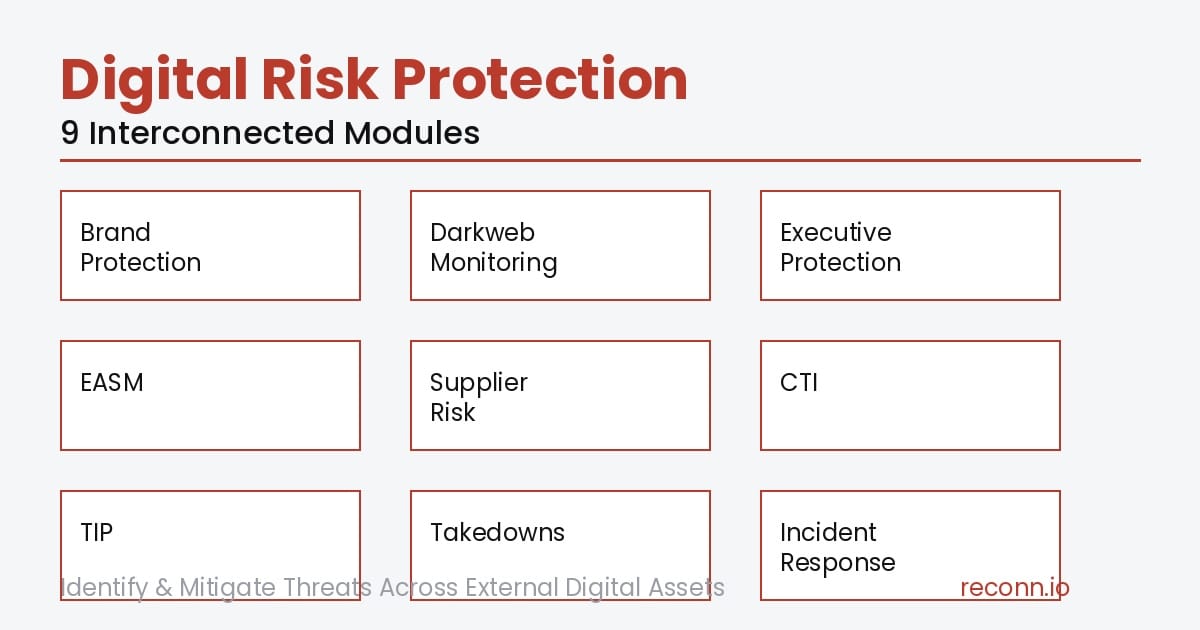
Module 1: Brand Protection - Safeguard Digital Assets
Counterfeit websites, fake sellers, phishing campaigns, malware-laden products. Detection identifies threats. Takedowns remove them. Ongoing monitoring prevents recurrence.
Brand protection helps mitigate digital risks to your brand and safeguard customer trust through continuous scanning, detection, and takedown coordination.
Module 2: Executive Digital Protection
Fake profiles impersonating executives. Personal impersonation in phishing campaigns. Detected and removed rapidly.
Executive digital protection safeguard personal identities and prevent social engineering attacks targeting your leadership.
Module 3: Darkweb Monitoring
Credentials on dark web forums. Company data for sale. Ransomware claims. Threat intelligence about upcoming attacks.
Continuous threat monitoring of dark web and deep and dark web Forums. Security teams receive alerts when organization's data appears. This helps mitigate threats before criminals exploit them.
"We discovered our executive credentials on the dark web three months after a vendor breach. If we hadn't been monitoring, we wouldn't have known. Attackers would have had months to use those credentials. Instead, we rotated them in 24 hours." — Chief Information Security Officer, GCC Enterprise
Module 4: External Attack Surface Management
Exposed cloud buckets, databases, code repositories, vulnerable systems, malware sources. Assessment and remediation.
EASM identifies threats to an organization's digital assets through internet scanning and exposure detection.
Module 5: Supplier Risk Scoring
Vendor security assessment. Certification monitoring. Breach tracking. Risk scoring.
Vendor assessment helps mitigate cyber risk in your supply chain and protect digital assets through third-party security evaluation.
Module 6: Cyber Threat Intelligence
Indicators of compromise, threat actor profiles, attack methods, phishing campaigns, malware sources.
CTI provides threat intelligence about threats that originate outside your organization, allowing proactive defense.
Module 7: Threat Intelligence Platforms
Feed consolidation, enrichment, alerting, automation.
TIP centralizes detection and response for faster reaction to threats across multiple sources.
Module 8: Takedowns & Disruption
Removal of fake domains, phishing pages, counterfeit sites, impersonation accounts, malicious content.
Takedown capabilities identify and mitigate threats through coordinated removal efforts.
Module 9: Incident Response in Darkweb
Legal engagement with threat actors, credential recovery, ransom negotiation where lawful.
Darkweb incident response helps mitigate damage when data is already compromised on dark web forums.
Digital Risk Protection vs Traditional Cybersecurity Tools: DRP Strategies
Traditional cybersecurity tools protect internal networks. Digital risk protection service safeguards external digital assets and threats that originate outside your perimeter.
DRP vs traditional approaches differ fundamentally:
- Traditional: Reactive. DRP: Proactive identifying and mitigating.
- Traditional: Internal. DRP: External.
- Traditional: Current attacks. DRP: Future threats.
Effective drp provides what traditional cybersecurity tools cannot: external threat visibility, brand protection, darkweb intelligence, supply chain security.
Understanding the Internet: Surface Web, Deep Web, and Dark Web
Many people confuse the dark web with the deep web. Let's clarify what digital risk protection actually monitors.
Surface Web:
The visible internet. Google, social media, marketplaces, news sites. What most people use daily. This is where your brand impersonation and counterfeits typically appear first.
Deep Web:
Private but not hidden. Your email inbox, banking portal, medical records, subscription content. It's not indexed by Google but it's accessible with proper authentication. Digital risk protection monitors deep web for your organization's exposed data.
Dark Web:
Intentionally hidden and requires specific software (Tor) to access. Criminal marketplaces, ransomware gang forums, paste sites where credentials are sold. This is where breached data, leaked credentials, and stolen intellectual property get traded. Darkweb monitoring scans these dark web forums and dark web marketplaces for your organization's information.
Digital risk protection service scans all three layers. Your brand could be counterfeited on the surface web (marketplaces). Your credentials could be leaked on paste sites (deep web). Your customer data could be sold on dark web forums (dark web).
Understanding these layers helps explain why digital risk protection extends beyond what traditional cybersecurity can see. Traditional tools protect your internal systems. Digital risk protection monitors where your organization appears across the entire internet—surface web, deep web, and dark web.
How to Get Started: The Reconn Digital Risk Protection Initiative (Updated Timeline)
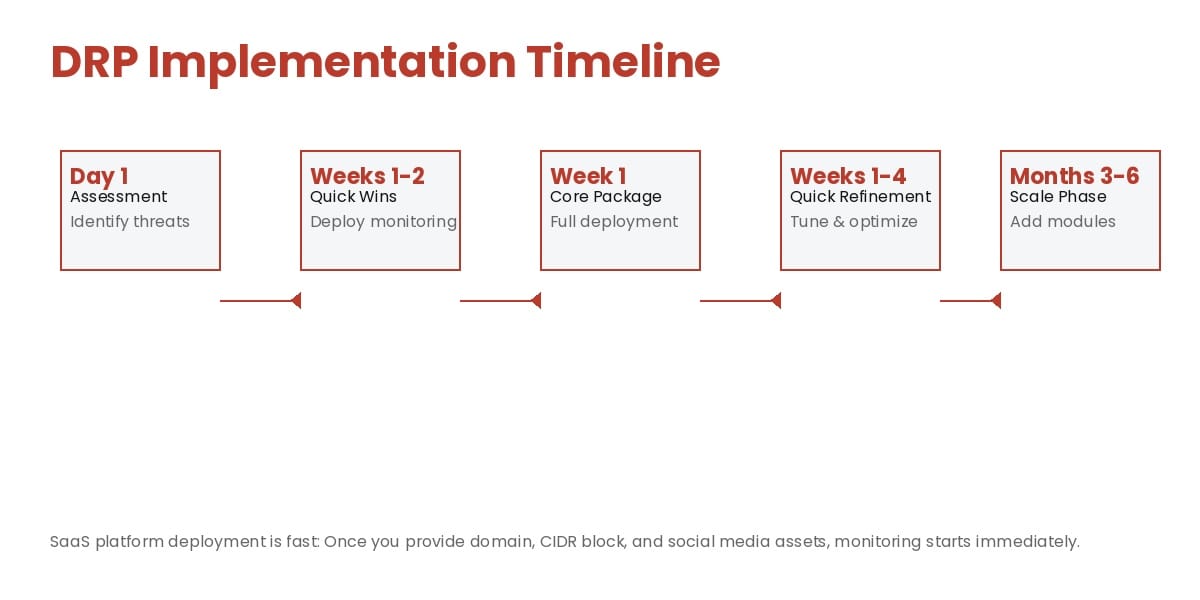
Day 1: Assessment
Assess your digital risk footprint and digital environment. Scan for counterfeits. Check dark web and deep web for leaked credentials. Analyze external assets. Identify executive impersonation. Evaluate vendor risks and supply chain risk.
Deliverable: List of digital threats, priority ranking, actionable intelligence and action plan to automate threat responses.
Weeks 1-2: Quick Wins
Implement immediate protection through domain monitoring, marketplace scanning, social media scanning, takedowns. Security teams see quick results. DRP tools scan automatically and generate drp alerts.
"The speed surprised us. We expected 3-4 months. The platform was scanning our environment in week one. Quick wins appeared in two weeks. By month three, we had visibility we didn't think possible."— CTO, Saudi SaaS Startup
Months 1-2: Core Package
Once you provide your domain, CIDR block, and social media assets, the SaaS platform immediately starts the digital risk protection service. Week 1 implementation gets your core package operational:
- Brand Protection scanning across marketplaces and social media
- Darkweb and deep web monitoring for leaked credentials
- Executive Digital Protection detecting impersonation
- Takedown processes established
- CTI Feeds activated and providing actionable intelligence
The SaaS platform automates deployment. You provide access credentials and organizational context. The platform starts scanning the internet immediately.
Weeks 1-4: Quick Wins and Results
Initial scans produce results. Threats are identified and prioritized. False positives are tuned. Alert thresholds refined. Security teams begin receiving actionable intelligence and drp alerts. First takedowns occur.
Months 3-6: Scaling
Expand to EASM, Supplier Scoring, TIP based on priorities. DRP extends your risk mitigation across all 9 modules.
Timeline: Assessment 1 day, quick wins 1-2 weeks, full core package first week implementation (SaaS deploys immediately once you provide domain/CIDR block/social media assets), quick wins and refinement 1-4 weeks, scaling 3-6 months.
Cost: Starts from $25K+ annually for core package.
ROI: 2-3 months typical payback through breach prevention, data leak prevention, brand recovery, compliance. DRP helps prevent costly incidents because implementation is fast and the platform starts protecting immediately.
Let's assess your digital risk footprint in one day.
We scan your digital environment, identify threats, and show you exactly what you need. Most organizations see quick wins within 1-2 weeks.
FAQ: Digital Risk Protection for Middle East and Africa Enterprises
Q: Is digital risk protection just another cybersecurity tool?
A: No. Traditional cybersecurity tools protect internal networks. Digital risk protection safeguards external digital assets and digital risks. A drp solution protects external digital assets and digital risks.
Q: Which digital risk protection module should Middle East organizations implement first?
A: Start with biggest risk. Most prioritize Brand Protection, Darkweb Monitoring, or Executive Digital Protection. For Middle East enterprises, brand protection addresses counterfeits and impersonation immediately.
Q: Do we need all 9 digital risk protection modules?
A: Depends on organization. Most need 4-5 core modules to adequately protect digital assets and mitigate digital risks. Middle East and Africa organizations typically start with the core package.
Q: How long does digital risk protection implementation take?
A: Assessment 1 day. Quick wins 1-2 weeks. Full core package implementation first week (SaaS platform starts scanning immediately once you provide domain, CIDR block, social media assets). Scaling 3-6 months. The platform automates most work.
Q: Is digital risk protection required by regulators in Middle East and Africa?
A: Yes. UAE Central Bank, SAMA, DFSA all require drp solutions to help mitigate digital risks. Most Middle East and Africa regulators require digital risk protection.
Q: What's minimum digital risk protection investment for Middle East organizations?
A: Core package with Brand Protection, Darkweb, Executive Protection, Takedowns, CTI. Most Middle East and Africa organizations scale from there.
Digital Risk Protection Is No Longer Optional
Digital risks exist everywhere. Regulators demand drp solutions. Organizations implementing early are ahead. Those waiting catch up reactively.
Your digital risks grow as your footprint expands. Digital risk protection service key capabilities help you identify and mitigate threats before they become breaches.
Ready to Understand Your Digital Risk Posture?
One strategic drp solution covers all 9 modules. We've helped 150+ organizations implement digital risk protection.
Your digital risks won't disappear. Digital risk protection helps you find and fix them.
We've implemented digital risk protection for 150+ organizations across the Middle East and Africa. Let's talk about what your organization needs.